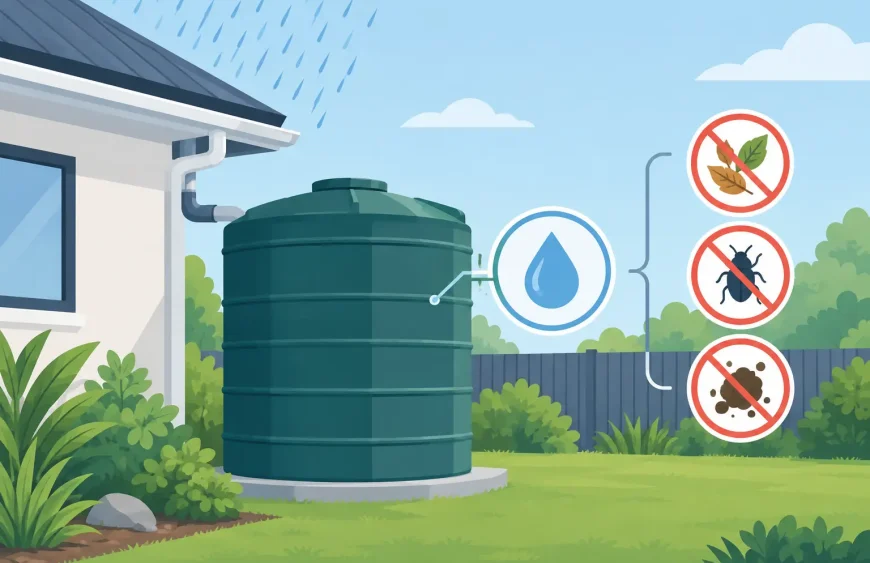
A rainwater tank can fill with far more than rain. Leaves, moss, grit, bird droppings, insects and roof debris all travel downhill when a proper storm arrives. Preventing rainwater tank contamination is therefore not a job for one filter fitted and forgotten. It is a chain of practical measures, starting at the roof and ending at the outlet.
For garden watering, toilet flushing or washing down hard surfaces, cleaner stored water means fewer blocked pumps, valves and hose fittings. If the water may be used for drinking, cooking or personal washing, the standard needs to be much higher. Treat domestic rainwater as non-potable unless the whole system has been designed, maintained and tested for safe potable use.
Preventing rainwater tank contamination starts at the roof
Your roof is the collection surface, so its condition directly affects what enters the tank. A clean, sound tiled or metal roof is generally easier to manage than one covered in moss, overhanging branches and nesting activity. After a dry spell, the first heavy rain can wash a surprising amount of accumulated dirt into the gutters in minutes.
Keep branches cut back where practical. This reduces leaf fall, shade-driven moss growth and the chance of birds sitting directly above the collection area. It also makes gutter cleaning less of a recurring battle.
Pay attention to roof materials and repairs. Old lead flashing, deteriorating coatings, asbestos cement sheets or roofs treated with unsuitable chemicals can introduce risks that a simple leaf filter will not solve. Water collected from questionable surfaces is better kept for non-sensitive uses, or not collected at all until the issue is resolved.
Do not wash the roof with detergents, biocides or moss killer if the runoff feeds your tank, unless you have isolated the system first. These products may be useful on the roof but are not useful in stored water, around pumps or on plants.
Stop debris before it reaches the tank
The most cost-effective place to catch contamination is before it enters the tank. Gutter guards and downpipe screens deal with larger leaves and twigs, but they are not a substitute for clearing gutters. Fine material can still build up beneath them, particularly under trees or near a busy road.
At the tank inlet, fit a properly supported filter that matches the size of the pipe and expected flow. A coarse mesh keeps out large debris, while a finer inlet screen catches smaller particles. The trade-off is simple: finer filtration produces cleaner water, but it needs cleaning more often and can restrict flow in a cloudburst if it is undersized.
Choose a filter arrangement you can actually reach. An awkward filter tends to become a neglected filter. A removable mesh basket, accessible inlet guard or purpose-built filter housing makes routine cleaning quick rather than a half-day job involving ladders and improvised tools.
For systems handling a lot of roof runoff, a first-flush diverter is worth considering. It sends the initial dirty water from a rainfall event away from the tank, allowing the cleaner follow-on water to be collected. It is particularly useful where dust, pollen, bird mess or fine roof debris is common. However, it must be sized for the roof area and emptied or reset as intended. A neglected diverter can become another place for stagnant water and sludge to collect.
Keep the tank closed, shaded and properly vented
An open tank is an invitation to contamination. Light encourages algae, gaps invite insects and rodents, and an uncovered inlet gives wind-blown debris a direct route inside. The lid should fit securely, while any vent or overflow opening needs a fine, durable insect mesh.
Shade also helps. Sunlight warming the tank encourages biological growth, especially in clear or light-coloured containers. An opaque tank is usually the straightforward answer. If the tank is exposed, keep pipework and access covers protected from direct sun where possible.
The overflow deserves the same attention as the inlet. During prolonged rain, water can back up through a poorly designed overflow, carrying debris into the tank or allowing pests to enter. Fit mesh that will not rust away, inspect it regularly and make sure discharged water runs away from the base rather than creating a muddy, pest-friendly area beside the tank.
A sound base matters too. Place the tank on a level, fully supported foundation. A tank that settles or leans can strain fittings, create leaks and make sediment management more difficult. Keep the surrounding area clear enough to inspect connections, clean filters and spot trouble early.
Separate clean water from settled sediment
Even a well-managed system will collect a small amount of fine sediment over time. The aim is not perfection. The aim is to stop that sediment reaching the outlet, pump and hose.
Avoid drawing water from the very bottom of the tank unless the system is specifically designed for it. This is where settled grit, organic matter and sludge collect. A floating pickup takes water from below the surface, where it is generally cleaner, while a suitably positioned outlet can leave a sediment layer undisturbed at the base.
If you use a pump, protect it with an appropriate pre-filter. Fine particles can wear pump components, jam spray nozzles and block drip irrigation surprisingly quickly. For gravity-fed systems, an outlet mesh filter can stop larger debris from travelling down the line, making cleaning and maintenance far easier than dismantling a blocked tap or hose.
TMI Shop’s practical approach to mesh filtration is built around this simple principle: catch debris where it is accessible, rather than waiting for it to cause a mess further down the system.
Give your tank a simple maintenance routine
Rainwater harvesting works best when maintenance is tied to the seasons, not postponed until the water smells odd or the pump loses pressure. You do not need to overcomplicate it, but you do need to inspect the parts that collect debris.
At least every few months, and more often during autumn leaf fall, check the following:
- Gutters, downpipes and guards for leaves, moss and standing debris.
- Inlet filters and baskets for blocked mesh or damaged fittings.
- Tank lids, vents and overflows for gaps, cracked covers and failed insect screens.
- Water appearance and smell for unusual cloudiness, algae or stale odours.
- Outlet filters, taps and pump strainers for reduced flow or sediment.
After major roof work, high winds, nearby building work or a long dry spell followed by heavy rain, inspect the system sooner. These events often produce a sudden load of grit and debris that normal rainfall does not.
A full tank clean is not needed on a fixed calendar if the water remains clear and the upstream filtration is doing its job. But if sediment has built up, algae are present, or the tank has been contaminated by an animal, dirty floodwater or a chemical spill, emptying and cleaning it properly is the sensible move. Isolate the incoming flow, remove the contaminated water safely for its intended non-potable disposal route, scrub accessible surfaces, rinse, and clean or replace filters before recommissioning.
Know when the water should not be used
Cloudy water is not always dangerous, and clear water is not automatically clean. Use your senses as an early warning, not as a safety test. A sour smell, visible algae, dead insects, animal droppings, oily residue or a sudden change in colour means stop using the water for any sensitive purpose until you have found the cause.
For ordinary garden use, the response may be as simple as cleaning the inlet and removing sediment. For water feeding appliances, livestock, edible crops or household uses, be more cautious. Identify whether contamination came from the roof, a damaged tank, a pest entry point or contaminated pipework. If there is any doubt about water intended for people, arrange suitable testing and follow the advice that applies to your installation.
The best rainwater systems are not the ones with the most gadgets. They are the ones with a clean collection surface, sensible filtration, a sealed tank and parts you can inspect without a struggle. Build those basics in from the start, and your stored water will stay cleaner while your pumps, hoses and weekends stay free of unnecessary trouble.