An IBC full of water, fuel or process liquid is useful right up to the moment the outlet does not connect to the hose you need. IBC valve adapters solve that awkward gap between a standard container valve and the real job at hand: filling watering cans, feeding a pump, running a hose, filtering rainwater or transferring liquid without a puddle around your boots.
The catch is that IBC fittings are not as universal as they first appear. Two outlets can look almost identical and still have different thread forms, seal arrangements or valve designs. Buy by appearance alone and you can end up with a fitting that starts on the thread, then jams, leaks or falls short of making a proper seal. A Mad Approach to Practical Design starts with the boring but vital question: what exactly is on the tank already?
What IBC valve adapters actually do
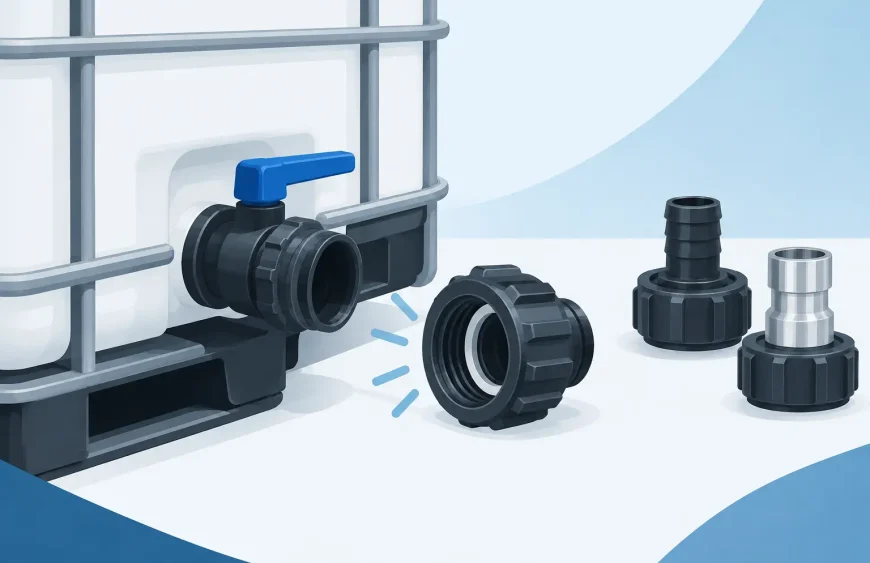
Most intermediate bulk containers have a bottom outlet valve, commonly around two inches in size. The valve is designed for controlled bulk discharge, but its connection is rarely ideal for every smaller-scale task. An adapter changes that outlet into a connection you can use, whether that is a hose tail, a smaller threaded outlet, a cam and groove coupling, a tap or a filter assembly.
That sounds simple, but the adapter also has to manage pressure, weight and movement. A short length of hose filled with water pulls down on the outlet. A pump can create vibration. A garden hose gets dragged across a yard. A well-chosen fitting gives the hose a secure, supported connection instead of turning the IBC valve into a weak point.
For rainwater harvesting, an adapter may allow a standard hose or irrigation fitting to be fitted to a tank. In a workshop or on a smallholding, it can make a controlled feed to a pump or drum practical. For biodiesel and other compatible liquids, the material of the adapter and its seal matters just as much as the thread. The right part is not simply the one that screws on. It is the one that suits the liquid, the flow rate and the way the equipment will be used.
The first job: identify the valve thread
Many IBCs use an S60x6 coarse buttress thread, often also described as a DIN 61 connection. This is the common large IBC outlet format seen on many 1000-litre containers, but common is not the same as guaranteed. Some tanks use a different size, a fine thread, a male rather than female outlet, or a valve arrangement that has been altered by a previous owner.
Do not assume a two-inch BSP fitting will mate with a typical IBC valve just because both are described as two inches. BSP refers to a pipe thread standard. S60x6 refers to the large coarse thread used on many IBC outlet valves. They are different connections, and forcing one onto the other is an excellent way to damage a valve and create a leak that no amount of thread tape will cure.
The most reliable check is to inspect the existing outlet with the valve closed and empty enough to work safely. Look at whether the outer thread is on the valve itself or inside a removable cap. Measure the outside diameter where possible, count the thread starts if visible, and note whether there is a flat sealing face for a washer. A clear photo of the outlet beside a tape measure is also far more useful than saying it is “about two inches”.
Some IBC valves have a removable outlet cap that reveals the connection you need. Others have a built-in coarse thread from the outset. Check that the cap is not actually part of a reducer or an old adapter before ordering another fitting. Layers of previous fixes are common on reused tanks.
Thread fit is only half the connection
A fitting can feel tight and still leak if the seal is wrong. Many IBC adapters seal against a washer or gasket compressed on a flat face, rather than through the thread itself. That means PTFE tape may do little or nothing for the actual sealing point. It can even encourage overtightening, which risks distorting plastic threads or pinching the seal.
Inspect the gasket before fitting. It should sit flat, be free from cracks and match the liquid being handled. EPDM is commonly suitable for water-based use, while nitrile is often selected where oils and fuels are involved. Chemical compatibility is never a guesswork exercise: confirm the liquid, concentration and temperature against the fitting and seal material before use. A container that once held one product may also retain residues, so it should not be repurposed casually for drinking water or another sensitive application.
Choose the outlet for the job, not for the catalogue photo
Once the tank-side thread is confirmed, the useful question becomes what the adapter needs to connect to. A hose tail is a straightforward choice for a permanent or semi-permanent hose run. Select a tail with an outside diameter that matches the hose internal diameter, then use a proper hose clip suited to the application. A loose clip on a full-bore outlet can turn a quick filling job into a very fast flood.
For a hose that is regularly connected and removed, a quick-release style coupling or cam and groove arrangement may be more practical. It costs more than a simple tail, but saves time where tanks are swapped, pumps are moved between containers or different hoses are used for different jobs. Keep mating coupling types consistent across your setup. A useful system becomes irritating quickly when every hose ends in a different standard.
A threaded reducer is the better route when connecting a pump, filter housing, tap or another fixed component. Here, consider flow rate before reducing the outlet too far. A large IBC valve can deliver water quickly. Reducing immediately to a small-bore connection may be perfectly sensible for drip irrigation or a tap, but it will restrict gravity flow and can make pump priming slower. Bigger is not always better, but an undersized outlet is often noticed at the least convenient moment.
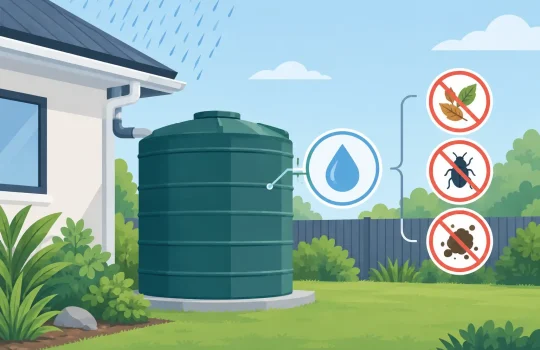
If debris is a concern, put filtration into the plan rather than hoping it stays at the bottom of the tank. Stored rainwater can carry leaf fragments, sediment and insects. A suitable outlet mesh filter can help protect pumps, valves and nozzles, although it needs regular cleaning to avoid becoming the restriction in the system. Filtration on the outlet protects downstream equipment; keeping debris out at the inlet reduces the cleaning work in the first place.
Fit IBC valve adapters without creating a leak
Start with the IBC on stable, level ground and make sure the outlet valve is fully closed. If the container is full, do not lean on the valve or use it as a handle. Support the hose separately, particularly if it is long, heavy or likely to be pulled.
Clean the outlet face and threads so grit cannot cut the gasket or cross-thread the adapter. Offer the fitting up squarely and turn it by hand. It should engage smoothly. If it catches after a turn or two, stop and check the thread rather than applying more force. Plastic threads can be damaged surprisingly easily, and replacement valves are a nuisance nobody needs.
Tighten until the seal is compressed and the connection is secure, not until every last ounce of strength has been used. Then test slowly. Open the valve a small amount, inspect the adapter, hose connection and any downstream joints, and only increase the flow once everything remains dry. This small test is particularly worthwhile after moving an IBC, changing a hose or using the setup in colder weather, when seals can stiffen.
For fuel, biodiesel or any liquid with safety, environmental or fire risks, work within the relevant storage and handling requirements. Use compatible components, contain possible drips and never treat a generic plastic fitting as suitable merely because it physically fits. The same caution applies to pressurised systems. Most IBC outlet arrangements are intended for gravity discharge or correctly designed pump setups, not improvised pressure vessels.
Common mistakes that waste time and liquid
The usual failures are predictable. The first is confusing an IBC coarse thread with BSP. The second is choosing a hose tail based on its outside measurement without checking the hose bore. The third is reusing a flattened or chemically unsuitable washer because it looks close enough.
Another is fitting an adapter to a tired valve and blaming the adapter when it leaks. Check the valve body, handle and outlet neck for cracks, damage or deformation. Reused IBCs are handy, but their fittings may have had a hard working life. If the valve itself is compromised, replacing or repairing the adapter alone will not create a dependable setup.
Finally, think about how the container will be emptied. A high-flow outlet may be useful for bulk transfer but unnecessarily lively for filling small containers. A tap or smaller controlled outlet can reduce splashing and waste. Conversely, a tiny connection may be frustrating when you need to shift several hundred litres before rain arrives or a job starts.
TMI Shop designs practical fluid-handling parts around this sort of real-world frustration: the connection that nearly fits, the hose that keeps slipping, and the filter that is easier to fit than clean. The useful fix is always the one that makes the whole task simpler, not just the checkout basket fuller.
A properly matched IBC adapter turns a bulk container from a blunt storage vessel into a working part of your setup. Measure the valve, match the seal and connection, support the hose, then test at low flow. Get those details right and the next transfer should end in the container you intended, rather than across the yard.