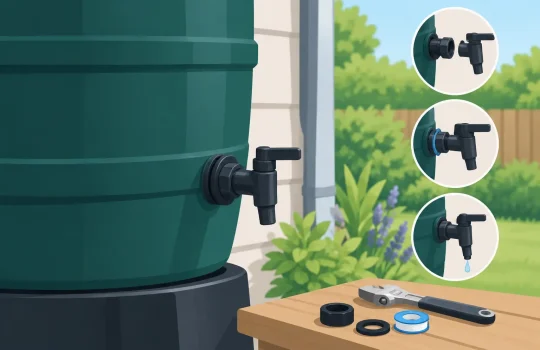
A fuel can that dribbles down its side, a rainwater tank outlet clogged with leaves, or a van floor littered with loose kit are not glamorous problems. They are, however, the sort that waste time, create mess and make a straightforward job needlessly awkward. The best British-made inventions start there: with an irritation that somebody who actually uses the equipment has decided to fix properly.
This guide to British-made inventions is not about celebrating a flag on a label for its own sake. It is about recognising the value of practical, purpose-built design. For tradespeople, mechanics, gardeners, smallholders and hands-on DIYers, a well-designed specialist fitting can be worth far more than a cheaper generic alternative that needs adapting before it will do the job.
What makes an invention genuinely useful?
A useful invention earns its place by removing a real point of friction. It may make pouring cleaner, keep debris out of stored water, put an awkward tool where you can reach it, or stop a hose from kinking at the worst possible moment. The result should be obvious in use: less waste, fewer spills, faster work or a tidier workspace.
That sounds simple, but it rules out a surprising amount of novelty clutter. A clever-looking item is not necessarily a clever solution. If it adds parts, creates another thing to clean, only works in ideal conditions or requires you to alter the rest of your setup, it may be more gimmick than invention.
The strongest designs tend to share three qualities. They address a specific job, they are easy to understand without a manual, and they withstand repeated use. A fuel spout should direct fuel where it needs to go. A mesh filter should let water pass while stopping the debris that causes trouble later. A holder should hold its item securely rather than simply looking organised on a product page.
A guide to British-made inventions starts with the problem
British manufacturing is at its most useful when it stays close to the problem being solved. Small-scale makers, workshop inventors and specialist businesses often spot frustrations that large mass-market suppliers ignore. Their customers are using old machinery, non-standard containers, particular hose sizes, confined spaces or equipment that has to work outdoors in British weather.
This is where niche products come into their own. A standard accessory may technically fit, but a purpose-designed alternative can make the job cleaner and quicker. Consider liquid transfer. A broad, ill-fitting funnel may be fine for topping up a bottle on a bench. It is less helpful when you are filling equipment in a yard, working around a vehicle or transferring biodiesel without wanting it on your hands, floor or paintwork.
The same thinking applies to storage. Generic hooks and plastic trays have their place, but they rarely account for how people actually use vans, workshops, caravans or sheds. A compact holder designed around a particular item can stop it rolling about, protect it from damage and make it easier to find when time matters.
British-made does not automatically mean better. It should mean there is a clear chain between the person identifying the problem, the person refining the design and the product you receive. Ask whether the item appears designed for a real task or merely sourced because it fills a catalogue category.
Look beyond the phrase made in Britain
The words British-made can cover different levels of local involvement. Some products are designed in Britain but produced elsewhere. Others are assembled here from imported components. Others are manufactured and finished in the UK by the business selling them. None of these arrangements is automatically wrong, but they are not identical.
If local manufacture matters to you, look for plain language about where the product is designed and made. A specialist maker should be able to explain what the product does, which materials have been chosen and why its shape, fitting or construction differs from the obvious alternative.
Material choice deserves attention too. In the fluid-handling world, compatibility is not an optional detail. A fitting suitable for water may not be suitable for fuel. A hose that behaves well with one liquid may harden, swell or degrade with another. If you handle biodiesel, chemicals or drinking water, check that the product is intended for that application rather than assuming a similar-looking item will cope.
There is a trade-off here. Specialist British-made items can cost more than bulk imported equivalents. That extra cost may reflect lower production runs, stronger materials, more careful testing or the fact that somebody has spent time designing out a problem. It is worth paying when the product prevents contamination, avoids repeated replacement or saves you from cleaning up a spill. For an occasional, low-risk job, a basic item may be perfectly sensible.
Put practical design to the test
Before buying any niche invention, picture the job from start to finish. Where will you use it? What are you connecting it to? Will you wear gloves? Will it be exposed to mud, frost, vibration or sunlight? The right product is not always the most complicated one. It is the one that works reliably in your conditions.
For liquid-transfer accessories, check the connection type, diameter and reach. A spout that is too short may still leave you balancing a container at an awkward angle. One without a secure fit can turn a clean pour into a slow leak. If filtration is involved, think about what you need to stop. Large leaves, roof grit, insects and fine sediment require different approaches, and very fine filtration can reduce flow if it is not matched to the system.
For storage products, measure first. It is a dull step, but it prevents a great deal of wasted effort. Check clearance around doors, drawers and equipment, as well as the item’s weight when full or in use. A holder in the wrong place is not organisation. It is just another obstruction.
Signs the design has been thought through
Practical products often reveal their quality in the small details. Look for a shape that can be gripped with dirty or gloved hands, edges that are easy to clean, sensible drainage, secure mounting points and materials that suit the environment. If a component is likely to wear, ask whether it can be replaced without throwing away the whole product.
Instructions and product descriptions matter as well. They should state limitations clearly. A maker that tells you a fitting is for a particular outlet size, liquid or use case is doing you a favour. Vague claims such as universal fit often mean you will be doing the adaptation yourself.
Why specialist inventions beat generic workarounds
Most practical people can make something work. Tape can hold a temporary repair, a cut-down bottle can act as a funnel, and a bungee cord can secure almost anything for a short journey. The trouble begins when a temporary workaround becomes the everyday method.
Repeated workarounds cost more than they seem to. They take a few extra minutes each time, create small spills, wear out faster and increase the chance of damaging tools, vehicles or stored supplies. Worse, they normalise an awkward process until somebody sees a purpose-built solution and wonders why they tolerated the old method for so long.
That is the value of inventor-led products. They are usually created by someone who has faced the same nuisance repeatedly and decided that good enough was not good enough. TMI Shop works from that practical mindset: a mad approach to practical design, but with the emphasis firmly on practical. The aim is not to sell another accessory. It is to make a fiddly job cleaner, quicker or easier to manage.
Buy for the job you do, not the one on the packet
The best purchase is rarely the product with the broadest claim. It is the one that suits your container, workspace, vehicle, system and routine. Be specific about the problem. Are you trying to prevent a splash when filling? Keep roof debris out of collected rainwater? Store a hose without it tangling? Move liquid without contaminating it? Once the problem is clear, the right design becomes much easier to spot.
A good British-made invention should feel unsurprising after the first use. Not because it is unremarkable, but because it solves the problem so neatly that it becomes part of the job. That is a far better test than novelty, clever packaging or a bargain price. Buy the piece of kit that lets you get on with the work, keep the mess down and put your time towards something more useful.